Are you an overwhelmed teacher, just trying to figure out how to make it through the end of the school day? (Let alone the end of the school year?) There is so much pressure on teachers to be everything to everyone, and if we aren’t taking the time to rest, we’ll head straight for teacher burnout!
In addition to this pressure, many of us find it hard to disconnect when we get home. When you’re a teacher, it’s too easy for work to follow you home. You’ve got lesson plans to write, high expectations from administrators, reports on student behaviors to make, and so much more that can fill your brain to the point of exhaustion.
If you want to have a different experience, it’s time to learn to do things differently. The following are some of my best tips for overwhelmed teachers to help bring the joy back to your teaching career.

What’s Putting the Pressure on You as an Overwhelmed Teacher?
It can be easy to look at other teachers or even others in other professions and think, “they’ve got it under control, why can’t I?”
But one of the most important things to realize is that we only see what people let us see. And, even on its best days, teaching is a demanding profession. So, before you get into comparison with others, just pause and realize that teaching has so many pressures. (And a lot of the people you look up to might be another overwhelmed teacher themselves!) The pressure you’re under can look like:
- An ever-growing workload
- Managing student behaviors and difficult classes
- The pressure to love what you do, even if the passion has been drained out of you
- Feeling like there aren’t enough hours in the day for everything that’s asked of you
- Trying to do it all with a smile on when your energy is depleted
Not being able to handle all of these things isn’t a reflection of your worth or abilities. It’s reflective of a system that puts too much on you without teaching you the best way to keep from losing yourself in the process.
The First Step for an Overwhelmed Teacher
It may sound annoying, and possibly even too simple, but the first step you need to take, whether you’re a new teacher in your first year or a seasoned pro, is taking care of yourself. I know…it sounds too easy. But what does it mean?
It means pouring some of the love you shower your students with back into yourself. This can look like practicing simple, sustainable self-care so you can recharge. And, it means carving out pockets of time for you to have a personal life, enjoy the good things around you, and balance your emotional state, so you don’t end up in burnout.
Before we get into the tips, I want to help you understand something. You don’t have to start with a complete overhaul of everything. In fact, you shouldn’t. Sometimes, starting with one small change or two can release the pressure you’ve been living with just enough to help you have the space to create your path forward.
Now, let’s get into what this can look like in the different areas of your life as a teacher.
Get the FREE Checklist – The Ultimate Guide: 25 Working Smart Tips for Busy Teachers
Moving Away from Overwhelm, to Order
Now’s a very good time to reassess where you’re at as a teacher. There are a few different places you can look to decide where to start. What’s stressing you out the most?
- Feeling like there aren’t enough hours in the day?
- Dealing with a classroom that’s out of control?
- Not having time to rest and recharge in between all of your duties?
I know that you’re probably thinking, “IT’S ALL OF THESE!” And I get that. But it’ll make a huge difference even if you choose just one place to start focusing your attention, and then build up from there.
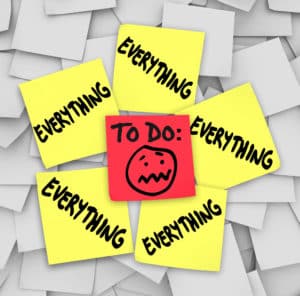
Tips for the Overwhelmed Teacher
Following the areas I just discussed, there are three areas in which you’ll focus to help overcome your teacher stress. They are productivity, classroom management, and self-care.
We’ll start with productivity, because that’s what’s going to give you more bang for your buck, as they say, by giving you more hours in your day. Then, you’ll have the mental energy and time you need to focus on the other areas.
Productivity tips for the overwhelmed teacher:
One of the key factors of working smarter as a teacher and to help cut the overwhelm is being very proficient in time management.
As a capable professional, in the ever-demanding and changing industry of education, you WILL need to be a very good manager of your time.
Following are some practical tips to help improve your productivity.
You’ll probably know many of them, but I’m hoping you will use them to add to your tool-belt of strategies to help you work smarter this year.
- Implement a structured email policy. Make sure you know what times in the day you will check emails (let your parents know when this is, for example, 8:00 am and 3:00 pm). Then, stick to this as a rule. Also, decide never to read emails or parent messages on your phone. It’s counterproductive, and you can’t get work-life balance if you keep doing this.
- Have defined office hours. These are times you meet with parents, or you have times for other meetings. Advertise your office hours in your back-to-school ‘meet the teacher’ correspondence or weekly email. You can also add them to your email footer, so they’re being regularly communicated.
- Set defined working hours that are non-negotiable. Eight hours per day is a good guide. (Something like – 8:00 – 5:00 pm or 7:30 – 4:30). By doing this helps set limits and gain a better work-life balance.
- Use your planning time wisely. Make sure you have a list of what you’ll need to complete at these times and stick to it (Try to avoid using planning time chatting with other teachers. There’s a time and a place for that, but if you make it your planning time, you’ll miss out on time needed to stay caught up.) Make it count!
- Manage your time wisely while you are at work – this should go without saying
- Get to school early, ready for work. It may sound simple, but arriving prepared will help you be more productive and eliminate that feeling that you’re behind and spending the whole day catching up.
- Work collaboratively with a team. If you share your jobs and delegate activities to teachers in your team, this will save each of you a great deal of time and help reduce your workload
- Work at school until you are finished or until you reach your deadline. This is a great work-life balance tip that keeps you from bringing things home with you.
- Use a to-do list and learn to prioritise your tasks. Simple, but effective.
- Batch similar jobs together. This is a clever way to be more productive with your time
- Don’t be too proud to ask for help if you need it. We all need help at times, and this is a healthy way to reduce that feeling of overwhelm.
- Track your working hours to make the invisible visible. This will help you know how many hours you work each day or each week & if necessary, you can see where time is being spent. It can be very enlightening and also a clever way to reduce time wastage. If you want to get very granular, use a time-tracking app like Toggl to track specific projects.
- Have a good routine in place. Know what your week looks like, following a predictable pattern. This will streamline your time and cut back on some unnecessary thinking.
- Set some goals. Do this for your professional and personal life. This will help keep you motivated and focus your energy on what is important
Get the FREE Work Smart Checklist Here:
Classroom Management Tips for the Overwhelmed Teacher
Classroom Management is another key factor in working productively as a teacher. Excellent teachers with classrooms that run smoothly understand that predictable routines and well-communicated classroom expectations lessen overwhelm. Additionally, it keeps you from having to reinvent the wheel every year, and becomes easier and easier over time.
- Have a documented Classroom Management plan that you teach your students and review often. Very important!
- Teach and model your classroom rules so that your expectations are clear to your students, and when you review them often with your students it will become a habit for them
- Implement a student jobs policy in your classroom. If you can effectively use your student helpers in your room, it will cut back on your workload with minor things, developing a system that is duplicatable and self-running, saving you a great deal of your valuable time.
- Become proficient in the necessary skills for behaviour management.
Self-care tips for the Overwhelmed Teacher
The final thing you should incorporate if you’re dealing with overwhelm is self-care. And I know that there’s a lot of eye-rolling that happens when this is brought up, however, the simple shift of learning to prioritize yourself can make all the difference for the classroom teacher.
When you take time to practice self-care, you’re acknowledging to your nervous system and your subconscious mind that you’re worth the effort. By starting with the big tasks of honing in on your productivity and getting your classroom running smoothly, you’ll have enough time to focus on your mental and physical health and combat the chronic stress that can often come with teaching.
If you are not maintaining your best physical and mental health, you’ll find it very difficult to manage your life as a teacher. Use the following self-care suggestions to improve your well-being and health:
- Learn to make yourself a priority and practise a regular self-care routine.
- Manage your stress levels and practise relaxation strategies.
- Take care of your teaching voice. It’s your most important resource. (Check out the post and get the free printable information sheet)
- Practice Mindfulness. This is a great way to relieve stress in your teaching day.
- Unplug from technology regularly. Switching off from technology regularly will give your brain a rest from constant overstimulation, helping you to not be such an overwhelmed teacher.
- Have some regular downtime to recharge. Consider taking a self-care/mental health-care day.
- Take your lunch breaks and sit down to eat without distractions as often as you can. This signals to your body that you’re safe and that you’re worth taking time out for.
- Find a caring teaching confidant and debrief with them regularly. Regular talks can help you download what’s on your mind, deal with any strong emotions that have come up, and is necessary to stop overwhelm as a teacher.
- Make sure you are sleeping well for at least 8 hours per night. When you’re well-rested, it’s easier to notice all of the amazing things about being a teacher, as opposed to stressing out about all of the challenges.
- Learn to set limits and boundaries for yourself. While I know you have high standards and want to do your best, it doesn’t mean you need to say ‘yes’ all the time.
- Develop work-life balance. When you can separate your home life from the excessive demands of being a teacher, you’ll experience more positive emotions when you’re with your loved ones and avoid the Sunday night anxiety (known as Sunday scaries!)
- Practice daily gratitude journaling to support your wellbeing. It’s a great way to focus on the positives of your life and lift your mood.
- Fit some walking into your day. Fitting in some exercise every single day, even if it’s just a walk, can support your well-being as a teacher.
- Prioritize something you truly love in your week and do it. It might be bushwalking or painting. It doesn’t matter what it is, as long as it’s YOUR passion.
- Let go of teacher guilt because you are already an awesome teacher. Just let it go! * Insert Frozen reference here *
Don’t forget to get your FREE checklist here:
Take Back Control, One Intentional Shift at a Time
First, take a breath in the present moment and remind yourself that you don’t have to fix everything at once. Instead of overhauling your entire lesson plans, redesigning bulletin board displays, and answering endless phone calls from students’ parents, choose one small shift that moves you in the right direction. When you focus on fewer things, you actually protect your energy. Then, your student outcomes improve because you’re no longer operating from survival mode as an overwhelmed teacher.
Next, commit to trying one new idea during your planning period this week. For example, you might block out buffer days at the beginning of the year so you aren’t racing to prepare for the next day. Or perhaps you decide to limit after-hours grading so you can finally end your end of the day feeling calm instead of drained. Although it may not seem like much time, these small boundaries compound over the course of an hour work week—and eventually, over an entire school year.
However, real change requires more than inspiration. You must be willing to get out of your own head and take aligned action. If you’re a high school teacher juggling field trips, creative tasks, and the latest new technologies, it’s easy to tell yourself this is just part of the job. Yet overwhelm on a regular basis is not sustainable, and unchecked stress can contribute to burnout and even anxiety disorders.
Ultimately, you are the professional. And although you may feel stretched thin, you still have agency over your time, your energy, and your boundaries. So instead of skimming this whole post and thinking, “I already know this,” choose one change to implement before your next task. Then notice how that single decision begins to shift your week in a powerful way.
Conclusion: Small Boundaries Create Big Change for the Overwhelmed Teacher
In the end, you don’t need a brand-new system, a new book, or membership in the 40-hour teacher workweek club to feel better and stop being an overwhelmed teacher. What you need is clarity, courage, and consistent action. When you intentionally protect your time (even if it’s just a little), you create space for better focus, stronger student outcomes, and more peace at the end of the day.
So start today. Pick one boundary. Try one adjustment. Schedule one buffer. Then evaluate what worked and refine it the next time. Because sustainable change doesn’t happen through doing more. It happens through doing what matters most.
You deserve a career that feels meaningful without costing you your well-being. And with one intentional step, you can begin moving there now.
PIN THIS FOR LATER!

Remember you’re worth it!
Michelle x




Leave a Reply