As a teacher, you will need a solid classroom management plan if you want to avoid burnout.
As teachers, we do so much more than teach lessons. We provide positive reinforcement for good behavior, foster a positive learning environment, study student behavior and development, and do all of this while working under the high expectations of administration.
We end up spending every day as caregivers, nurses, psychologists, and one of the main sources of learning interpersonal skills for many of our students.
All that said, getting an effective classroom management plan together can go a long way in supporting a positive classroom culture. But it takes time and experimentation before you will know what will work for you.
Each year, it can change, too, depending on the cohort of students you have. You will need a different approach depending on whether you’re working with older students or younger kids. It also comes back to your own philosophy of behaviour management.
I believe that if you can get your classroom management plan established and automated, your days in the classroom will run much more smoothly. This is especially important for the first year of teaching. While you won’t get everything right, you’ll have a firm foundation to go from.
Then, you’ll have the energy to focus on the more time-intensive tasks that are required each day like marking, lesson planning and reporting, and reading and responding to emails, just to name a few.
This post contains affiliate links. For the full Disclosure Policy, see here.
Steps to make your classroom management plan successful.
If you want to have a well-managed classroom, I can’t overstate the importance of having clear and explicit instructions. This list of rules and school policies can help curb inappropriate behavior before it takes root. And more importantly, you must adhere to your set of rules every day.
Consistency in classroom routines and how you address behavioral problems will foster an environment of mutual respect between you and your students.
Tips to implement your classroom management plan
1. Teach your behavior management plan to your students first thing every term.
2. Display clear and explicit charts around the room. Need help? Check out the Teacher Toolbox for resources!
3. Talk about your behaviour expectations all year and follow through with them consistently. It’s the only way it will work!
I remember back being a first-year teacher. OH. MY. GOODNESS. My classroom was nothing but disruptive behavior all day.
If you came anywhere near my room, all you would hear was me screaming. “Sit down!” ‘Stop talking!”
The children were definitely in control. I wasn’t!
It was awful. I went home every night in tears, complaining to my husband how difficult it was.
If this feels familiar, I thoroughly recommend reading a wonderful book called Assertive Discipline: Positive Behavior Management for Today’s Classroom (Building Relationships with Difficult Students). It’s a must-read and helped me so much.
Because my first placement was so bad, I knew that I needed to become a better classroom manager and make my life easier as a teacher, otherwise I wouldn’t last long.
So, all of the following strategies and classroom expectations are ones I’ve collected together from a variety of sources, and I know they work.
By implementing them consistently, they have made me a much more effective teacher.
Each strategy can be quickly implemented to build a positive and supportive environment for any class.
*** Don’t worry if you haven’t initiated them at the beginning of the school year; it is very easy to implement and teach at any time of the school year.
A successful positive classroom management plan
While taking a proactive approach to your classroom management techniques is always going to make things easier, these strategies can be implemented any time to curb behavior problems.
1. Classroom Rules
It is your number one priority as a smart class manager to have a clear set of Classroom Rules that are explicitly taught to your students.
Class Rules are generally set by the class teacher and should state the required behaviour that you need from each student.
As the students get older, you can negotiate a set of rules for the entire class and find out what is important to them specifically. It helps the students take ownership of their behaviour because they were involved in the rule-making process.
Research tells us to limit our rules to maybe 5 or 6 simple rules starting with a verb.
I use rules that explicitly state the behaviour I’m looking for. For example
- Listen and follow instructions
- Raise your hand and wait to speak
- One person speaks at a time
- Speak politely and use your manners
- Use all equipment safely
I find these explicit rules are much better at preventing classroom management issues than statements like “show respect” or “be happy” because they clearly state the behaviour that is required.
Our school has overarching values of Respect, Kindness, Honesty, Cooperation, Self-Discipline, Learning, and Social Justice, which I link my classroom rules to.
If you have whole school rules or values, tailor your classroom rules specifically to these, as I have.
Related Article: Clever Classroom Rules: Tips for Teachers
2. Clip Behaviour Chart
I find an easy way to monitor and reward individual student behaviour is by using a behaviour clip chart that is displayed in a visible spot in your room.
Some teachers ask if they should use a behaviour chart and want to know if it works. Sometimes, visual aids can be a valuable indicator for students and a way of providing positive feedback. Additionally, I have had great success using one for many years now.
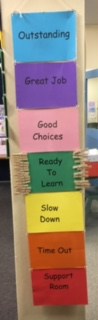
In my classroom, I use a chart that is stepped to encourage positive behaviour and has rewards and consequences built into each step.
To describe how it works: Each student has a named peg that is clipped to the chart. Students start each and every day in the middle at ‘Ready to Learn’, no matter what happened on the previous day.’
As the teacher identifies different student behaviours throughout the day, students are asked to move their pegs accordingly; up for positive behaviour and down for negative behaviours.
At each level above the starting point (Ready to Learn), you will have specific rewards set up, for example, stickers, certificates (positive notes homes), or privileges.
At each level below the start, set consequences like class time out, buddy classroom, or parent conferences.
All of these instructions should be clearly outlined in a poster and introduced at the beginning of the school year so that the students know how the system works.
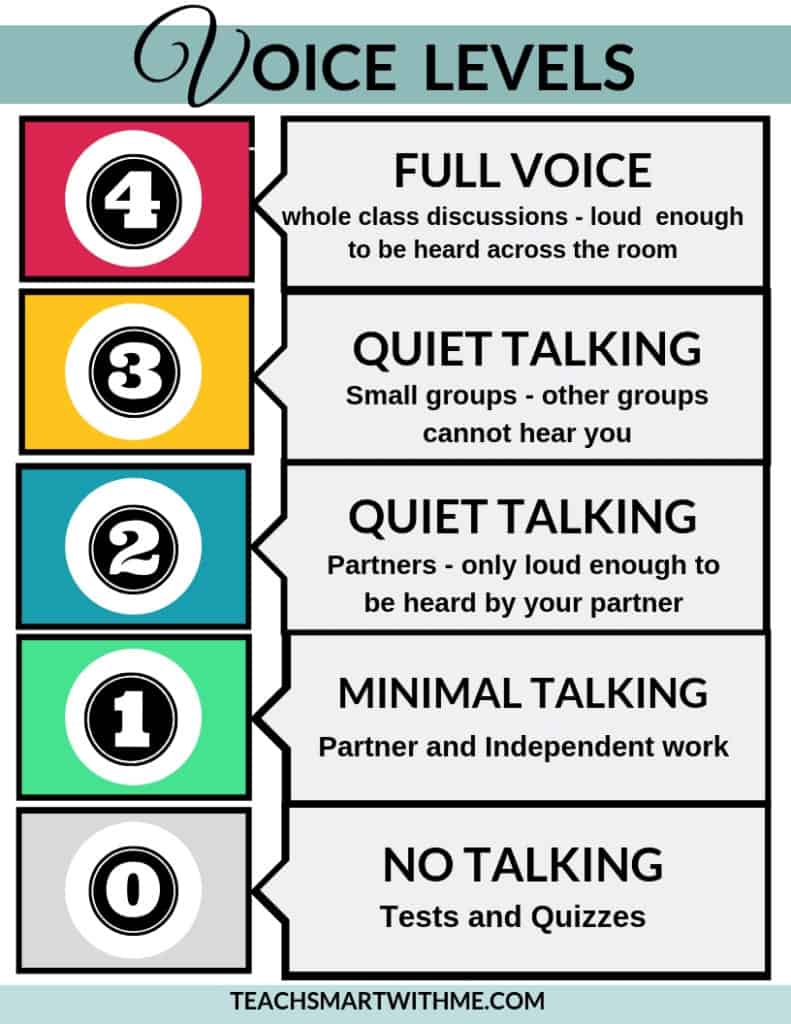
You might need help with the noise levels in your classroom. Get you FREE Voice Levels poster here:
3. Rewards System

Many education theorists encourage educators to develop their students’ intrinsic motivation to achieve success. Many believe that rewards don’t develop internal motivation as they reward extrinsic factors.
But, any good classroom manager knows that developing this internal driving force can be more difficult with younger children.
Extrinsic rewards work really well in any primary setting and also lower secondary. This type of reward system can help develop deeper motivation and student engagement, as well as have some fun in the process.
Implementing a Rewards System
Over the school year, I use a variety of rewards in my classroom, and I change them up over the year.
Here are some of the rewards that work well for grade 5, and I know work for younger students too.
- Sticker charts
- Ticket system – a system of classroom currency
- Classroom cash/bucks
- Raffle tickets that are drawn out of a box for prizes
- Certificates – I use a variety of certificates: daily, weekly, end of term, and end of year
- Prizes
(Don’t think that stickers won’t work for older grades. My son has used the coveted ‘scratch and sniff’ variety of stickers for grades 8 and 9, and they love them!)
Having a reward system that acknowledges individual behaviour, as well as rewarding whole class effort, are all great methods of developing responsible behaviours in your students.
4. Marbles in the Jar
As part of a whole class rewards system, I use what’s called ‘Marbles in the jar’. It’s a really useful way to reward the whole class when they are working well together.
It works as a more medium-term goal to work towards and builds class belonging, whole class cooperation and a sense of ‘class spirit.’
How it works: When the jar is full by an agreed time-frame (I have a time-frame goal of 5 weeks (midterm), the whole class receives a reward. This incentive is decided by a joint class agreement. (usually in a class meeting – see strategy 9).
When the students are all working well together as a class and are on task or they walk quietly together between classrooms or anything they do together etc, I add marbles to a jar.
Some of my previous classes have come up with some terrific incentives; for example, class parties, a movie and popcorn session, games sessions (outside and inside), pyjama days (actually I haven’t done that one yet, but I think it’s a great idea) and many others.
In one of my year 5 classes a few years ago, I had an empty fish tank in the classroom. I would tell my students that when the marble jar was filled I would buy the fish to put in it. It worked so well and was a huge incentive for whole-class on-task behaviours.
5. Attention Getters
A great strategy for your classroom management plan is to have some consistent ways to grab your student’s attention.
- Using fun callbacks, that the students know and learn, are a quick way to gain their attention. Callbacks also save valuable learning time, which we all know is key.
I use one or two different call-backs each term. You can change it up and teach them new callbacks whenever you like.
Read my post for some great examples of 10 Fun Attention Getters for the Classroom, with a free printable call-back poster.
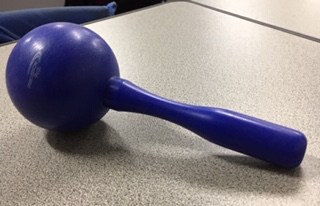
Another easy attention-getter can simply be a noisemaker of some sort. I use a maraca, but you could use a small bell to ring, or another musical instrument; like a whistle.
This sound-maker is necessary for classroom management to quickly gain the student’s attention, without the teacher having to yell out.
The musical noisemaker is a must to gain student attention in more noisy situations. For example when the students are occupied in cooperative small group activities.
6. Noise Meter or Voice Levels
An important classroom management strategy in any classroom is to monitor the amount of noise that the children are making in your room, especially in small group activities.
To have this working well, you need a system to teach the management of noise or voice levels. I use a Voice levels chart that has a numbering system matched with the type of classroom talk being undertaken.
This is a great way to explicitly teach students the level of talk and noise that is acceptable in each situation. Modelling examples of each voice level will also be needed.
For example: in a test or at assessment time, you tell the students that they will use voice level 0 – No talking or silence; or in a paired learning activity, “We will be using voice level 2 – Quiet talking – “your partner should be the only one to hear your voice”.
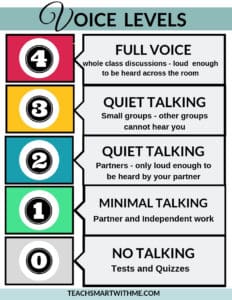
This is a terrific system of managing the noise level in your classroom if it is used consistently and modelled.
Download a copy of my FREE printable chart here:
7. Classroom Jobs
In any good classroom management plan, it’s very important to involve your students in the running of the day-to-day tasks of the classroom.
This helps lighten the exhaustive load on the classroom teacher as well as developing responsibility in your students.
A great way to get student involvement is to designate the classroom jobs to students to manage.
I use a simple system where I take volunteers or just randomly draw names from my ‘pick a stick’ to look after basic jobs like; lights and fans, opening and closing the door (we call it our classroom butler), whiteboard cleaner and resource collectors and handout people.
I know a lot of teachers use student jobs in the classroom, but understand that I see this is a strategic move to help reduce teacher workload.
If you are a new teacher or haven’t utilised this strategy in your classroom management plan, start today!
Related Article: Classroom Job: How to Effectively Use Student Helpers
8. Pick a Stick – with named paddle pop sticks
To make it easy to call on students and ask for volunteers I used a system of paddle pop sticks that are labelled with each student’s name. It’s is a great way to randomly draw out their names when you need them. I put all the sticks into a cup for easy access.
‘Pick a stick’ can be used for :
- Calling on any students to respond to teacher questions in a lesson (avoid the ‘hands up if you know the answer’ and ensures all students are listening and involved
- Drawing out student helpers for classroom jobs
- Pairing up students for buddy work – eg. reading partners and many other things
9. Class Meetings
Having a regular time for class meetings works well for a classroom management plan. It helps students to understand that they have a voice and they can share their ideas and thoughts with the class and be valued for their opinions.
In our regular (weekly) class meeting, we have discussions about what’s going well; questions that students are having and decisions that need to be made as a whole class, (like what reward needs to be decided on by the whole class after achieving a full marble jar).
10. Build Relationships with your Students
Research tells us that building personal relationships with each and every one of our students is a key strategy to be more successful with your behaviour and classroom management plan.
Your students won’t know how much you care until you take the time to find out who they are and get to know them.
Let them know about you as a real person too.
At the beginning of each school year, I tell my students about me and my family. I have a photo of my kids on my desk and I regularly talk about my own life and what I like to do.
Sharing these details really helps to relate to them on a personal level.
Related Article: Easy Back to School Activities for Teachers to get to know Your Students
11. Regularly Move Student Desks
I like this classroom management plan strategy because it gives all of your students a chance to work from different positions in the room.
It also helps the students to build relationships with all of there class members and develop cooperation skills, as well as helping to monitor behaviour and dynamics between students.
Plus, if they know that you move desks regularly, students will know that they are not stuck at the same desk all year. It also makes it a bit more interesting. (I use fun activities like musical chairs to change desks or just the ‘pick a stick. Sometimes I might just position them myself.)
Desk arrangement is another area to discuss here. I like starting the desks in rows, as I believe I get better lesson engagement, but later in the year, I put the desks into small groups to help with cooperative learning.
12. Deal with Lost Property Easily
Have an ‘I’m lost’ bin for lost property. (I got this idea from Miss Giraffe’s Class, who was giving out printable labels for the lost bin).
A designated place for all classroom lost belongings is a clever way to save time managing students belongings.
At the end of the school day, all unclaimed belongings or equipment is placed into the bin.
On a weekly basis, go through the items in the bin with your students to see if they are claimed.
This approach saves so much time and removes any responsibility the teacher feels to find owners of belonging every day.
Use these strategies as part of your full-year classroom management plan!
Conclusion: Your Classroom Management Plan Shapes Your Career
No matter what grade level you’re working with, having clear expectations for your classroom can help improve classroom behavior and create a more effective classroom management plan.
While student misbehavior can be expected from time to time, an effective plan and a student handbook to handle the negative behavior can go a long way in making your teaching career more sustainable.
I hope this list of ideas helps you all term long. These are tried and true methods that help create less chaotic daily routines and a clear path to a calm classroom.
PIN IT FOR LATER
Other Classroom Management Articles
https://teachsmartwithme.com/10-fun-attention-getters-to-gain-your-students-focus/




Leave a Reply