Classroom attention getters are short signals (spoken or silent) that pull the room back together, fast. They matter because they protect students’ attention, help students’ focus, and make transitions smoother. Instead of repeating yourself three times, you get a clear response pattern, and you can move on.
When I was a classroom teacher, I quickly discovered how important these signals were to my students and myself. Not only do they help save your voice as a teacher, but they also help you quickly manage the noise level in your classroom, preventing unnecessary stress and overwhelm throughout the day.
Below are practical, quick attention grabbers you can use on a daily basis, with options that suit middle school, high school, and a whole class. This is classroom management that doesn’t add stress, it takes it off your shoulders.
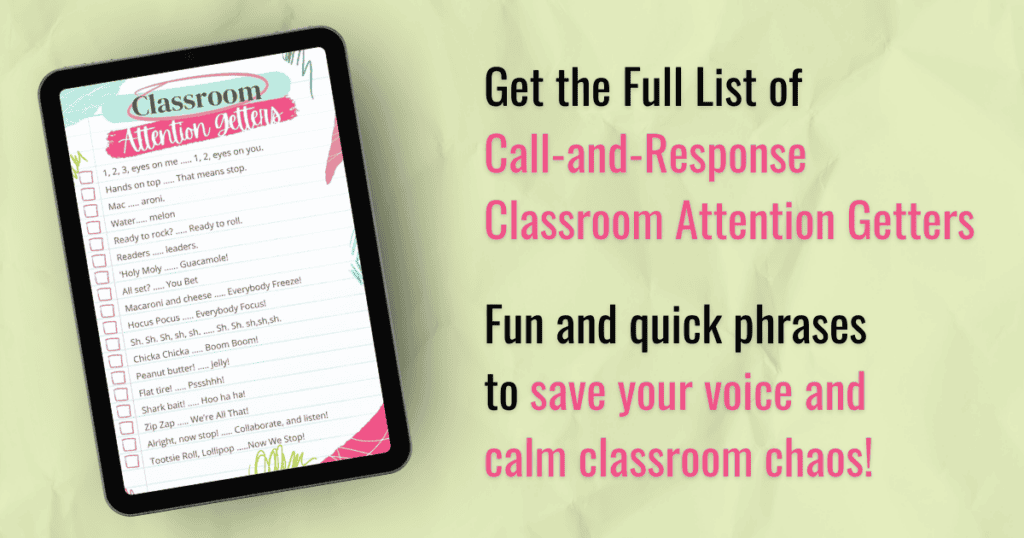
Click here to get the full list of classroom attention getters delivered to your inbox!
Pick the Right Attention Getter for Your Class, Not the Loudest One
The best way to choose from the many attention getters is to match the signal to three things: your students’ age, your room’s usual noise level, and your own energy. A great option in a calm Year 10 class might flop in a lively Year 3 room, and vice versa.
Start by asking, “Do I need them to stop talking, stop moving, or both?” If they’re on the floor and wriggly, a non-verbal cue plus a clear direction can be a good way to reset without turning it into a power contest. If they’re in group work, a short verbal cue can be a perfect way to cue “voices off, eyes up” without sounding sharp.
Whatever you choose, teach it properly at the beginning of the year. Don’t just use it and hope. Model the call, rehearse the response twice, then try it right before a transition. Keep it consistent for the school year, or you’ll waste enough time swapping signals that students stop taking any of them seriously. Two or three reliable classroom attention getters beat a rotating menu of “new” ones.
Verbal attention getters that feel calm, clear, and firm
Verbal attention getters work best when they’re quick, repeatable, and not too cute for your group. Here are a few you can use straight away:
- “Class, class.” Students respond, “Yes, yes.” It’s simple, it scales to a whole class, and you can change your tone (quiet to quiet, firm to firm) without getting loud.
- “Holy moly.” Students respond, “Guacamole.” This one is playful, but still structured, so it can be a fun way to regroup at the end of an activity.
- “Hocus pocus.” Students respond, “Everybody focus.” It’s a great way to link the cue to students’ focus, especially before you give further instructions.
- “If you can hear me, clap once.” Then twice, then stop. This works well when the rest of the class is chatty and you need layers of attention without calling out.
- “Show me five.” (Eyes, ears, mouth, hands, body.) Use it sparingly so it doesn’t become background noise.
One tip that saves stress: avoid using a student’s first name as your main attention getter. Use a first name only when needed for safety or a private redirection, otherwise it can turn into a public pushback.
Non-verbal classroom attention getters that save your voice
Non-verbal classroom attention getters are a great tool when you’re already hoarse, or you’re teaching in a noisy space like a hall. They also reduce the “teacher talks, students keep talking” loop, because you’re not adding more sound to compete with.
Here are some ideas of non-verbal classroom attention getters:
- A raised hand signal (students copy and stop)
- Lights off once, then on (a clear visual reset)
- Countdown fingers from five to one (As students notice, they also count their fingers down with you)
- Freeze and point (freeze your body, point to where eyes should go, like the board).
- For a calmer feel, use the soothing sound of a wind chime. It cuts through noise without spiking energy.
Accessibility matters here. Make sure every student can see the cue, or hear it, from their spot, and have a backup option for students who may miss visual or audio signals.
Fun and themed classroom attention getters (use them without losing control)
Themed attention getters can be particular attention grabbers for younger classes, and they can even work with older students if you keep them tight. The rule is simple: one call, one response, then silence.
You might use “Peanut butter!” with “Jelly!” as the response, or “Flat tire!” with “Pssshhh!” to end group noise quickly.
“Shark bait!” with “Hoo ha ha!” can be a high-energy reset for sport or drama groups, while “Tootsie roll!” with a short “tootsie” response can suit early years.
If your class loves music, use a clean, two-beat snippet from popular songs or favourite songs (no lyrics needed). Keep it teacher-led, two beats, stop. Some particular attention grabbers fit music teachers especially well because rhythm already means “listen now”.
Call and Response Classroom Attention Getters Students Learn Fast
Call-backs work because they’re predictable. Students know what comes next, so they respond on autopilot, and you get students’ attention quickly. That predictability is an easy way to reduce repeated directions and protect your own energy.
Teach call backs like a tiny routine: model it, practise it, praise it, then only give further instructions once you have the attention of your students. If you start explaining while half the room is still talking, you train them to ignore you.
Ready-to-use call-backs for any classroom
Keep the tone warm, not sarcastic. These are attention getters, not “gotcha” moments, but ways to get kids’ attention.
- 1, 2, 3, eyes on me ….. 1, 2, eyes on you.
- Hands on top ….. That means stop.
- Mac ..… aroni.
- Water….. melon
- Ready to rock? ….. Ready to roll.
- Readers ….. leaders.
- ‘Holy Moly …… Guacamole!
- All set? ….. You Bet
- Macaroni and cheese ….. Everybody Freeze!
- Hocus Pocus ….. Everybody Focus!
- Sh. Sh. Sh, sh, sh. ….. Sh. Sh. sh,sh,sh.
- Chicka Chicka ….. Boom Boom!
- Peanut butter! ….. Jelly!
- Flat tire! ….. Pssshhh!
- Shark bait! ….. Hoo ha ha!
- Zip Zap ….. We’re All That!
- Alright, now stop! ….. Collaborate, and listen!
- Tootsie Roll, Lollipop …..Now We Stop!
If you’re starting fresh, pick two callbacks and stick with them. Too many choices slow the response pattern.

Make Attention Getters Stick, Even on Tough Days
Attention getters don’t fail because you chose the “wrong” phrase. They fail when they aren’t trained, or when you stop using them the moment you get busy. Consistency is a great way to make any signal work, even when you’re tired.
Aim for two classroom attention getters to start (one verbal, one non-verbal), then add call-backs later. That’s enough variety without confusion. Put them on your plan for transitions you do every day, like moving to the mat, swapping subjects, or packing up. When you protect those moments, you protect student attention for the learning that follows.
If a signal stops working, don’t panic and don’t go louder. Re-teach it like it’s week one.
How to teach, practise, and reinforce classroom attention getters in under five minutes
Introduce the cue, tell students exactly what it should look like, then model it. Practise twice, fast. You can add a simple whole-brain style practice moment (you do it, they do it), without turning it into a big program.
Use it straight away before a transition to the next activity, then thank the class for the quick response. Positive reinforcement can be as simple as, “That was quick, now we can start,” no prizes needed.
What to do when students ignore your classroom attention getters (without escalating)
Stop talking. Wait. Scan the room, move closer to the noise, and keep your face calm. Repeat the attention getter once, then wait again. Fewer words is often the best way.
When you have silence, give the direction once. If students still ignore it, follow your predictable consequence or routine (seat change, pause time, re-do the transition). The key is follow-through, not volume. Over time, students learn that the signal means something, every time.
Classroom Attention Getters Benefit in More Ways Than One
The best way to use classroom attention getters is to keep them simple, consistent, and true to your style. Start with one verbal cue (like class, class, or hocus pocus) and one non-verbal cue (like a hand signal or the soothing sound of a wind chime). Once those are solid, add call-backs as a fun way to speed up transitions and protect students’ attention.
You don’t need a louder voice, you need a clearer routine. Save your energy, protect your voice, and let the signal do the heavy lifting.
Get your FREE list here:
Related Articles:
For more about Classroom Management reading my article called:
Other helpful posts to read:
A Simple Classroom Rewards System that Works
Clever Classroom Rules in Middle School: Tips for Teachers
Classroom Jobs: How to Effectively Use Student Helpers
12 Strategies for a Successful Classroom Management Plan + Freebie
PIN IT FOR LATER!
Michelle x
IN THE COMMENTS, LET ME KNOW OF SOME OTHER FUN ATTENTION-GRABBERS FOR THE CLASSROOM, THAT YOU USE. Thanks.




Leave a Reply